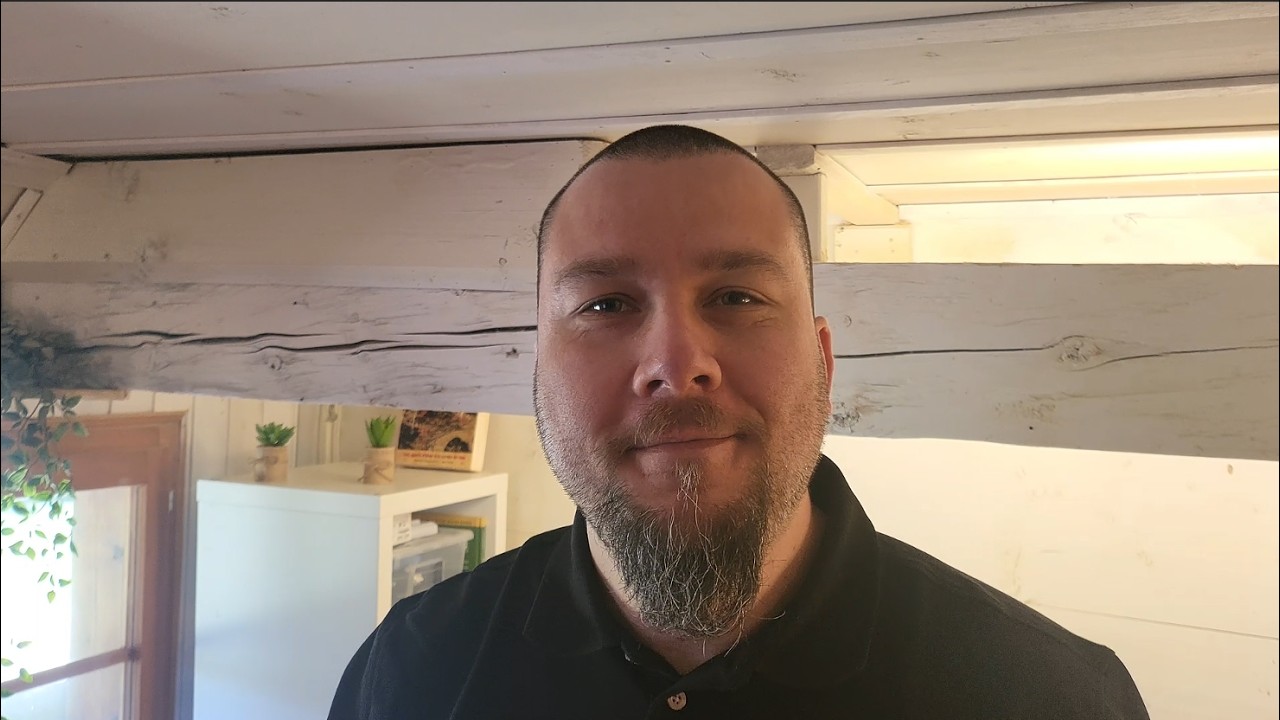
Zorbey Schuster lives and works in an old chalet in Le Sepey, which he has completely renovated inside. The building is about 160 m² over two floors, with the thick walls typical of a mountain chalet. Zorbey runs two businesses from it, Schuster Design and TakTakTak, with one of the rooms serving as his workshop.
Before OuiFi, the internet connection had been through several unsuccessful solutions. A cable line was available, but very slow. Zorbey then switched to 5G: the speed itself was fine, but the signal was extremely unstable, with frequent dropouts. The solution finally chosen was Starlink.
The challenge
The cable line wasn’t enough for everyday professional use, between running two businesses and working from the workshop. 5G, meant to solve that, brought a different kind of problem: a connection that drops without warning is almost worse than a slow one, especially in the middle of a call or a file transfer.
Then there was the Wi-Fi inside the chalet. With thick walls and two floors, a single box or a single central access point would never have covered the workshop, the office and the living areas evenly.
Finally, Le Sepey isn’t exactly next door. Distance has a direct impact on this kind of project: sending someone on site for every adjustment is neither practical nor quick.
The OuiFi approach
The heart of the installation is a UniFi Dream Machine Pro, connected to a USW 16 PoE switch that powers the whole network. For Wi-Fi, four access points cover the different areas of the chalet according to their needs: two U6+ for the main spaces, one of them dedicated to the workshop, a U6 In-Wall for the office, and a FlexHD for the outdoor area. A UniFi G4 Dome camera covers the chalet entrance.
Starlink replaces both the cable line and 5G as the connection source, solving the speed problem and the stability problem at the same time.
The most unusual detail of this project is that it was carried out entirely remotely. Zorbey received the equipment and installed it physically himself, following instructions sent via WhatsApp for connecting each device. The configuration and optimisation of the whole network were then done by connecting to the equipment remotely. For such a remote site, this avoided a trip while delivering the same level of configuration as an on-site visit.